


One of the safest and most efficient means of accessing a ship is through the accommodation ladder– a movable staircase used for safe embarkation and disembarkation of crew, visitors, and pilots.
These ladders are essential ship access equipment commonly rigged in harbors, at anchorage, or even at sea.
They serve as a reliable bridge between the vessel and the shore, especially where flat quays and concrete jetties are involved.
🛳️ Definition: Accommodation Ladder (Marine Terminology)
An accommodation ladder is a movable gangway used on merchant ships to allow safe access from the deck to the shore, pilot boat, or jetty.
It is rigged near the accommodation area (hence the name) and is operated using wires and a powered winch system that adjusts its height.
Unlike truly portable gangways, an accommodation ladder is semi-fixed.
It swings out from the ship’s side but remains tethered in one end.
⚙️ Key Features
- Controlled via air-driven or electric winches
- Moves one end vertically (up and down) using supporting wires
- Can be rigged together with a pilot ladder in a high-freeboard vessel (known as a combination ladder)
- Constructed using marine-grade aluminum or carbon steel
- Fitted with quay rollers to adjust to the jetty’s movement
💬 Why Is It Called an “Accommodation” Ladder?
The term comes from its installation point- adjacent to the ship’s accommodation block.
Since it provides access to the living quarters, the name became widely accepted across the maritime industry.
This marine terminology is rooted in traditional seamanship where descriptive naming made ship operations easier to communicate among crew.

Accommodation Ladder vs Gangway: Key Differences Explained
Seafarers often confuse accommodation ladders with gangways, but understanding their differences is crucial for safe ship access and proper rigging procedures.
Both ladders are used on the ship’s side to board or disembark a vessel, but their construction, portability, and purpose vary significantly.
Let’s break it down.
🧱 Side-by-Side Comparison Table
| Feature | Accommodation Ladder | Gangway |
|---|---|---|
| Location | Installed near accommodation area | Can be rigged on either port or starboard |
| Portability | Semi-fixed (hinged & wire-supported) | Fully portable (can be moved using cranes) |
| Movement | Vertical (up/down via winch and davit) | Manually deployed and fixed in place |
| Usage Area | Harbors, at sea, anchorage | Primarily for harbors and flat berths only |
| Combination Use | Can be rigged with pilot ladder (combination) | Cannot be used in combination |
| Construction | Rigid, wire-operated, aluminum or steel | Lightweight, usually aluminum |
| Rigging Direction | Along ship’s fore-and-aft axis (parallel) | Perpendicular to ship’s centerline |
| Deployment Method | Operated via winch and control system | Manual or assisted by shipboard crane |

🔧 Rigging and Construction Differences
- Accommodation ladders are rigged parallel to the ship’s centerline, usually facing the stern. They use supporting wires, a davit, and a winch system to suspend and adjust their height.
- Gangways, on the other hand, are deployed perpendicular to the ship and laid across jetties or wharfs. They are not suspended, making them unsuitable for use at sea or when the vessel is moving.
📜 Accommodation Ladder Regulations and Safety Requirements
Because accommodation ladders are critical for safe access to ships, international regulations govern their design, installation, and operation.
Whether used by crew, pilots, or port officials, the ladder must meet safety standards to prevent accidents and ensure compliance during inspections.
🌍 Regulatory Standards You Must Follow
The construction and use of accommodation ladders are regulated under the following international standards:
🔹 ISO 5488:2015
- Specifies construction and design standards for accommodation ladders.
- Covers materials, angle of inclination, safety markings, and load limits.
🔹 MSC.1/Circ.1331
- Guidelines for Construction, Installation, Maintenance, and Inspection/Survey of Means of Embarkation and Disembarkation
- Includes areas to be thoroughly examined during annual surveys.
🔹 ISO 7364:1983
- Shipbuilding and marine structures – Deck machinery – Accommodation ladder winches.
- Specifies requirements and characteristics of lightly powered ships’ accommodation ladder winches.
- Covers design and limitation, characteristics, and load testing.
🔹 SOLAS Chapter II-1 Regulation 3-9
- Specifies the use of a means of embarkation on and disembarkation from ships.
- Covers wires use for such means- gangways and accommodation ladder
⚠️ Mandatory Requirements for Use
To comply with international safety standards and port inspections, all vessels using accommodation ladders must follow these essential rules:
🔸 Installation
- Must be clear of suspended loads and rigged in unobstructed areas.
- Installed adjacent to the accommodation area or where boarding is safest.
🔸 Maximum Angle
- The ladder should never exceed 55° from the horizontal.
- This ensures a safe and comfortable slope for boarding and disembarking.
🔸 Visibility and Lighting
- Must be well-illuminated at night, including:
- Ladder structure
- Control area
- Upper and lower platforms
🔸 Life-Saving Equipment
- A lifebuoy with:
- Self-igniting light
- Buoyant lifeline
- Must be positioned near the ladder at all times.
🔸 Markings and Load Limits
- Clearly marked with:
- SWL (Safe Working Load)
- Maximum and minimum design angles
- Usage limitations (typically shown on metal plates at each end)
🔸 Safety Nets
- A safety net must be rigged:
- Under the ladder
- Along both sides
- Prevents accidental falls to the sea or quay.
🚢 Which Ships Are Required to Have One?
- All ships 120 meters and above in length must have an approved accommodation ladder onboard.
- This includes:
🔍 Pre-Use Inspection Checklist
Before every use, the responsible officer must inspect the ladder for:
- Broken or frayed operating wires
- Damaged or missing stanchions, handrails, manropes
- Bent or corroded davit arms or platforms
- Faulty or unresponsive winch and control box
💡 If any defect is found, do not rig the ladder until repairs are completed.
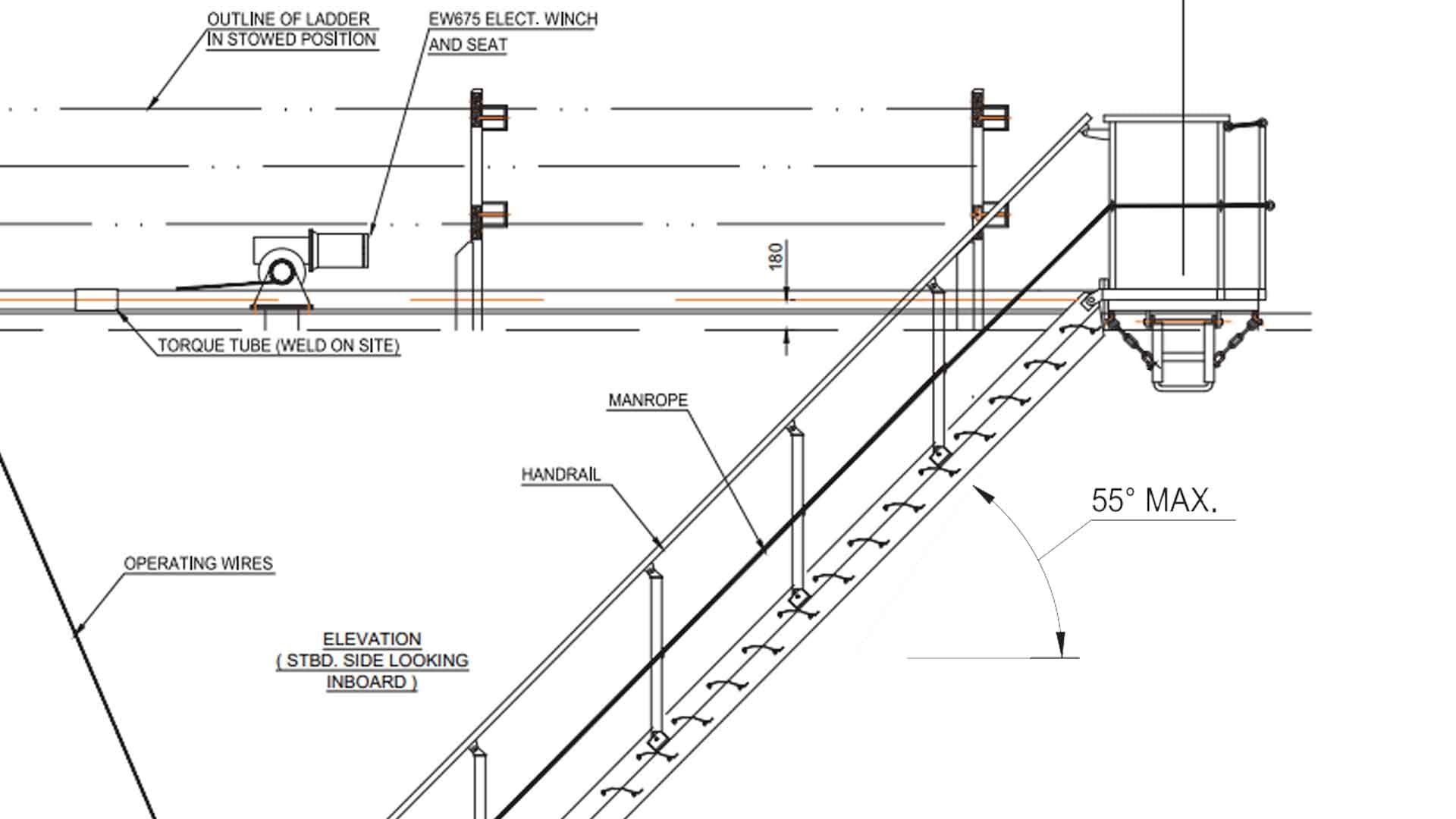
🧩 Main Parts of an Accommodation Ladder
Understanding the parts of an accommodation ladder helps deck crew perform proper rigging, inspections, and maintenance.
It’s also vital when reporting defects or ordering spare parts during drydock or replenishment.
Here are the 15 essential parts of a typical accommodation ladder system:
1. Main Ladder
- The primary structure that spans between the upper and lower platforms.
- Houses steps, rails, and support fittings.
2. Curved Steps (Tread Pitches)
- Designed to be safe at any inclination angle up to 55°.
- Anti-slip steps built into the ladder.
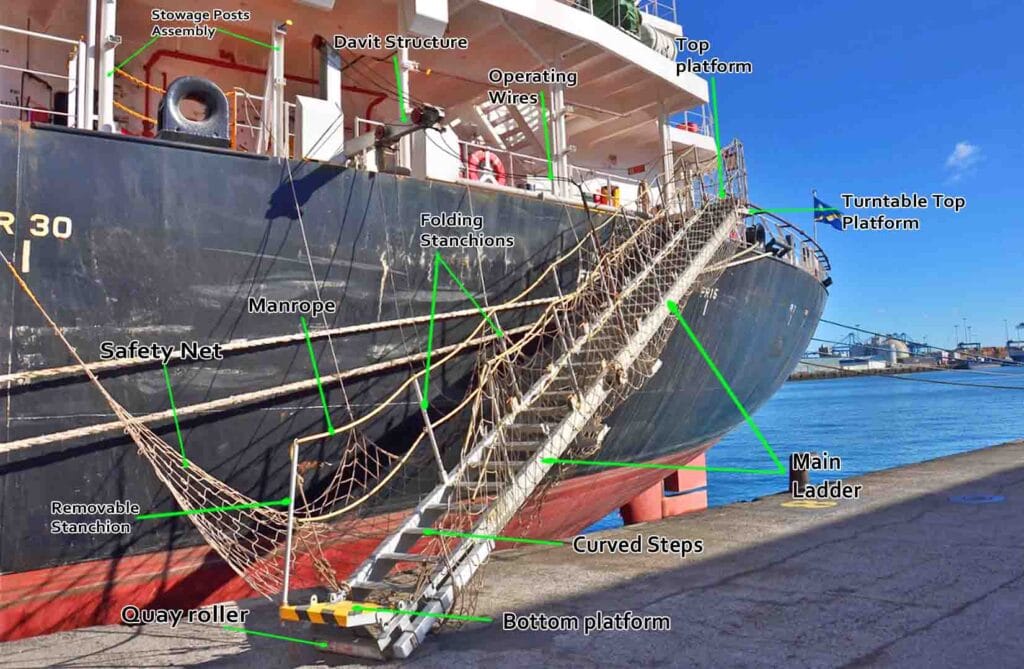
3. Folding Handrails
- Hinged rails attached to the ladder sides.
- Provides safe grip during ascent or descent.
4. Folding Stanchions
- Support rods that brace the handrails.
- Designed to fold during stowage and swing into position during rigging.
5. Removable Stanchions
- Installed at the top and bottom platforms.
- Secured with ropes or bolts to form safety barriers.
6. Bottom Platform
- Lower step-off point where the ladder touches the quay.
- Often stenciled with SWL and max number of persons.
7. Turntable (Top Platform)
- Circular stage at the upper end of the ladder.
- Can rotate to swing the ladder clear of bollards or fenders on the jetty.
8. Quay Roller
- A wheel located at the ladder’s foot.
- Helps absorb movement and rolling contact with the quay or jetty.
9. Understay (Wishbone)
- A diagonal support bar under the top platform.
- Provides rigid stability and counteracts lateral movement.
10. Stowage Posts Assembly
- Used to support and lock the ladder when stowed.
- Fixed posts installed on the deck.

11. Winch
- Powers the ladder’s vertical movement via an air-driven or electric motor.
- Connected to control systems with up/down/neutral lever settings.
12. Operating Wire
- Steel wire used to raise or lower the ladder.
- Passes through sheaves and rollers to distribute load.
13. Davit Arm / Davit Structure
- Suspends and supports the ladder from the deck edge.
- Rotates to swing ladder outward or inward during rigging.
14. Manropes
- Safety ropes running from top rail to the bottom stanchions.
- Prevent falls and improve balance for users.
15. Control Box
- Should always be kept clean, responsive, and labeled.
- Contains the lever that operates the winch.
🛠️ Maintenance Checklist for Accommodation Ladders
Because of its moving parts, an accommodation ladder requires scheduled maintenance and care to remain functional and safe.
Here’s a practical step-by-step guide followed onboard during inspections or PMS tasks:
🔄 Step-by-Step Maintenance Routine
1. Visual Inspection
- Check wires, sheaves, rollers, winch, and platforms for wear, corrosion, or cracks.
2. Power Check
- Connect and test the hydraulic, pneumatic, or electric source before operating the winch.
3. Greasing the Moving Parts
Pump grease into:
- Grease nipples on rotating shafts
- Wire sheaves
- Winch gears
- Folding joints on stanchions and rails
4. Rigging Exercise
- Swing the ladder out and test full up/down range.
- Observe any noisy winch operation, wire tension, or jerky movement.
5. Check Handrails and Stanchions
- Fold/unfold handrails and verify stability.
- Re-grease joints and reinforce loose fittings.
6. Inspect Platforms
- Look for rust, missing stencils, and test rotation of the turntable platform.
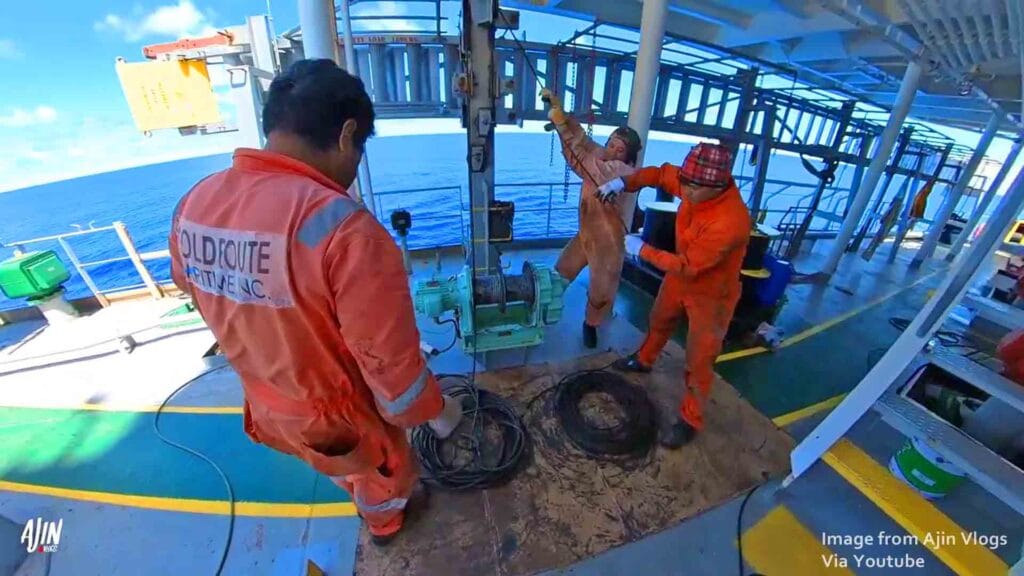
7. Lower Ladder
- Check wire movement through sheaves and reapply grease.
- Verify that rollers are moving
- Look for friction, damage, or deformities.
8. Corrosion Control
- Apply penetrating oil to stuck parts or rust-prone joints.
- Plan chipping and repainting if corrosion is significant.
9. Wire Renewal Check
- Verify replacement schedule in the Planned Maintenance System (PMS).
10. Final Inspection
- Return ladder to stowed position.
- Listen to the winch sound for mechanical issues.
- Wipe excess grease to avoid deck slips or audit remarks.
❓ Frequently Asked Questions (FAQ)
🔹 What is the difference between a gangway and an accommodation ladder?
An accommodation ladder is semi-fixed and suspended by wires enabling up or down movement at the ship’s side.
A gangway is fully portable, deployed perpendicular to the ship, and used primarily in port.
🔹 What is the safe angle for an accommodation ladder?
The maximum angle of an accommodation ladder should not exceed 55 degrees from the horizontal, as specified by ISO 5488:2015 and MSC.1/Circ.1331.
🔹 Are accommodation ladders required on all ships?
Yes, ships over 120 meters in length are required to carry approved accommodation ladders.
This includes tankers, bulkers, and other SOLAS-class vessels.
🔹 Can an accommodation ladder be used with a pilot ladder?
Yes. This configuration is called a combination ladder and is typically used on vessels with a high freeboard during pilot transfers.
🔹 What are the main parts of an accommodation ladder?
Key parts include the main ladder, turntable platform, winch, davit arm, quay roller, manropes, folding handrails, and operating wires.
🔹 How often should you maintain an accommodation ladder?
Maintenance should be done regularly as part of your Planned Maintenance System (PMS), with checks on wires, sheaves, platforms, and greasing points.
📢 Call to Action (CTA)
Proper knowledge of accommodation ladders helps prevent serious accidents and ensures safe, compliant boarding operations.
🚢 Want to learn more?
Check out related posts like:
- How to Rig a Pilot Ladder Safely
- List of Shipboard Drills and Their Frequency Schedules
- 31 Fire Fighting Equipment On Ships & Where to Find Them
🛠️ Bookmark this guide and share it with your crewmates because safety starts with knowledge!
May the winds be in your favor.
Leave a Reply