

Starting a career at sea often begins with a simple question: what’s the difference between an Ordinary Seaman (OS) and an Able Seaman (AB)?
⚓ Both are deck ratings and vital to ship operations, but they differ in experience, skills, and pay.
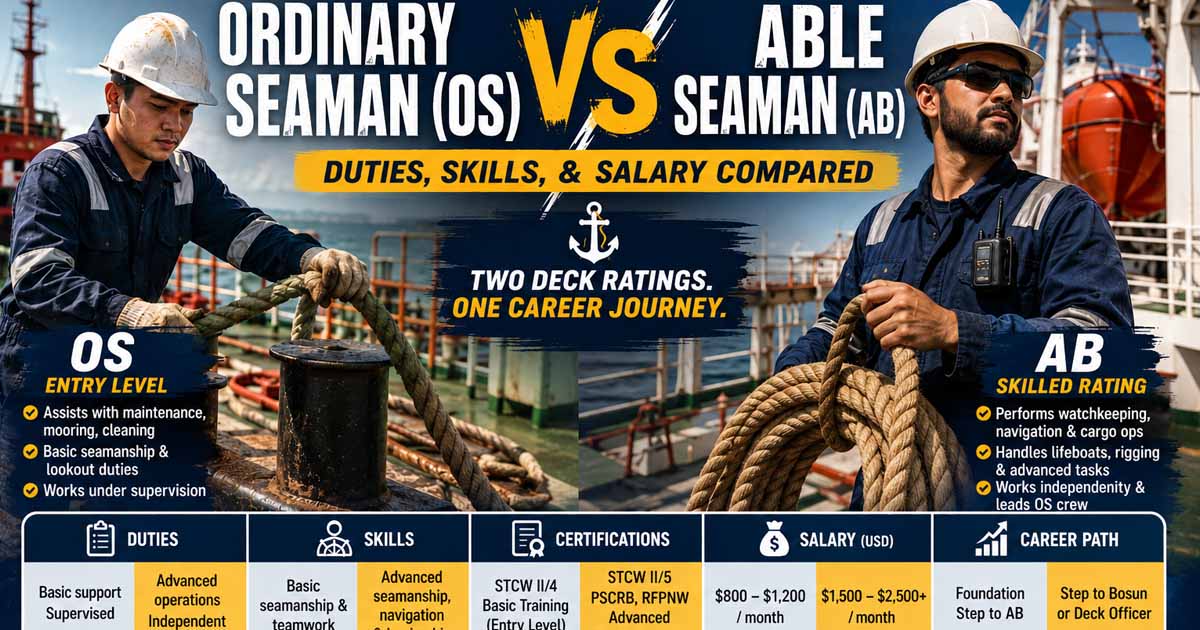
- An Ordinary Seaman (OS) is the entry-level deck rating, assisting with maintenance, mooring, cleaning, and basic seamanship under supervision.
- An Able Seaman (AB) is a skilled deck rating, trusted with navigation watch duties, lifeboat handling, rigging, and advanced seamanship tasks.
👉 This comparison matters for cadets, trainees, and aspiring seafarers because OS is the foundation of a maritime career, while AB is the stepping stone toward Bosun or Officer ranks.
Knowing the gap between them helps you plan your training, sea service, and career progression effectively.
OS vs AB at a Glance (Quick Comparison)
Summary Table: OS vs AB
Below is a side-by-side comparison of OS and AB roles, highlighting duties, skills, salary, and STCW requirements.
| Category | Ordinary Seaman (OS) | Able Seaman (AB) |
|---|---|---|
| Main Role | Entry-level deck rating assisting officers and ABs | Skilled deck rating performing independent seamanship duties |
| Duties | Chipping, painting, mooring, lookout duties | Steering, lookout, rigging, watchkeeping, lifeboat ops, cargo ops, advanced maintenance. |
| Skills | Basic seamanship, teamwork, safety drills | Advanced seamanship, navigation support, emergency response, deck machinery operations |
| Certifications | STCW Basic Training (BT), medical fitness, seafarer’s ID | OS certificates + STCW II/5 (Able Seafarer Deck), RFPNW Reg. II/4, Flag endorsements |
| Salary (average) | USD 900–1,200/month (varies by company, region, ship type) | USD 1,500–2,500/month (varies by company, region, ship type) |
| Career Path | Stepping stone to AB, may be promoted to OIC-NW if licensed. | Promotion path to Bosun, or Deck Officer (with further training) |
| Experience Needed | None to minimal | 180–360 days sea time |
Responsibility Overlap and Differences
Both OS and AB are deck ratings, meaning they work under the Chief Mate and Bosun.
Their duties overlap in maintenance (chipping, painting, cleaning, line handling), but the key differences are:
- Independence: ABs can stand watch, performs more advanced maintenance, take the helm, and act as lookout without constant supervision, while OS mainly assists.
- Certification level: OS needs only basic STCW, while AB requires higher endorsements and sea service.
- Pay & responsibility: ABs earn more because they carry greater responsibility in navigation and safety.
ABs often lead OS crew, requiring stronger technical and decision-making skills.
What is an Ordinary Seaman (OS)?
An Ordinary Seaman (OS) is the entry-level deckhand on a merchant ship.
This role introduces cadets and greenhorns to life at sea and prepares them for promotion to AB.
Duties and Responsibilities
- Assist ABs in mooring, line handling, and cargo operations.
- Chip, paint, and clean decks and accommodation areas.
- Handle garbage segregation and disposal according to MARPOL.
- Participate in safety drills and emergency musters.
- Act as a lookout under supervision.
- Report defects or safety hazards to senior crew.
- Standing lookout duty under officer supervision.
- Supporting basic cargo operations.
⚠️ Officers usually have low expectations for OS especially first time Ordinary Seamen. You have to work harder to earn their trust.
Required Skills
- Basic seamanship skills: knot-tying, rope handling, painting, deck tools.
- Teamwork & discipline: working in shifts and following chain of command.
- Basic safety knowledge: fire drills, abandon ship, personal survival, PPE compliance.
Required certifications
- STCW Basic Training (VI/1): Firefighting, personal survival, first aid, and personal safety.
- Vessel Personnel with Designated Security Duties (VPDSD)- company specific.
- Tanker Courses: BTOCTCO and BTLGTCO (Reg. V/1-1.1- and Reg. V/1-2.1) – company/ ship specific.
- Valid Seafarer’s Medical Fitness Certificate.
- Seaman’s book or equivalent national document.
Salary and Typical Contracts
- Philippines crew (international fleet): USD $800–$1,300/month
- US domestic fleet (ferries, MSC): USD $2,000–$3,000/month
- UK/Europe: £1,000–£1,600/month
Contracts typically run 6–9 months followed by 1–3 months of vacation. OS roles are often probationary, with the goal of promotion to AB after gaining sufficient sea service.
Like most seafarer’s salaries, theirs vary by region, vessel type, union agreements, and company as well. Overtime pay is common in high-intensity sectors.
What is an Able Seaman (AB)?
Duties and Responsibilities
An Able Seaman (AB) is a qualified deck rating who has demonstrated seamanship skills, sea service, and certification.
ABs are considered senior deckhands and are critical in navigation, safety, and cargo operations.
Duties and Responsibilities
- Stand navigation watch as lookout or helmsman
- Steer the vessel (manual steering when autopilot is disengaged)
- Operate and maintain lifeboats and survival craft
- Assist in rigging, anchoring, and mooring
- Carry out cargo lashing and securing
- Maintain deck equipment (winches, windlass, cranes)
- Lead OS crew in maintenance tasks
- Working on heights or over the ship’s side.
- Enters enclosed spaces with supervision from Chief Mate or any responsible officer
Advanced skills:
- Advanced seamanship: rigging, splicing, rope and wire work
- Navigation support: watchkeeping, helm orders, radar lookout, COLREGS basics
- Emergency response: firefighting teams, lifeboat launching, survival craft handling
- Regulation know-how: Knowledge of MARPOL and SOLAS safety practices.
Certifications:
- STCW Reg. II/5 – Able Seafarer Deck endorsement.
- Proficiency in Survival Craft and Rescue Boats (PSCRB).
- STCW Reg. II/4 – Ratings Forming Part of a Navigational Watch (RFPNW)
- STCW Basic Training (VI/1).
- Advanced training in firefighting, first aid, and security awareness.
- Basic and advanced tanker courses – company and vessel-specific requirements
Salary and Typical Contracts
- Philippines crew (international fleet): USD $1,500–$2,500/month
- US fleet (unionized ferries, MSC, offshore): USD $3,500–$5,000/month
- UK/Europe: £1,800–£2,800/month
Contracts range 6–9 months on international ships, while unionized domestic fleets (ferries, offshore supply, tankers) often have shorter rotations with higher pay.
Able-bodied seafarers are often eligible for overtime pay and bonuses depending on vessel type.
Skills Gap and Development Between OS and AB
The transition from OS to AB is not just about serving time at sea- it’s about developing technical competence, gaining leadership maturity, and meeting international certification standards.
Key Differences in Technical and Leadership Skills
While both OS and AB belong to the deck ratings, the technical scope and responsibility differ greatly:
- Technical:
- OS performs supervised maintenance, cleaning, and basic rope work.
- AB executes advanced seamanship, navigational support, and survival craft handling independently.
- Leadership:
- OS follows instructions from ABs, Bosun, or officers.
- AB often leads OS crew, supervises deck tasks, and acts as a responsible watchkeeper.
- Decision-making:
- ABs are trusted with emergency responses, helm orders, and safety roles, while OS remains in a supporting role.
👉 In practice, ABs are expected to show initiative and independent judgment, while OSs are trained to observe, learn, and build competence under guidance.
How OS Skills Lay the Foundation for AB Roles
The OS position is designed as a stepping stone toward AB. Skills gained as OS that directly prepare for AB include:
- Line handling & ropework → prepares for rigging and mooring leadership.
- Lookout duties → foundation for steering and navigation watch.
- Safety drills participation → develops emergency response confidence.
- Basic seamanship → evolves into advanced seamanship, splicing, and rigging as AB.
✅ By mastering OS-level tasks, a seafarer builds the discipline and seamanship required to pass AB certification and take on more responsibility.
Skills and Certifications (STCW II/4 vs II/5)
Under the STCW Convention, the career ladder from OS to AB is tied to training and sea service endorsements:
- STCW II/4 – Rating Forming Part of a Navigational Watch (RFPNW):
- Applies to OS-level watchkeeping duties.
- Requires basic safety training and limited sea service.
- Allows OS to perform lookout and helm duties under officer supervision.
- STCW II/5 – Able Seafarer Deck:
- Applies to AB-level duties.
- Requires 12–36 months sea service (depending on flag state).
- Proof of competence in rigging, seamanship, survival craft, and navigation support.
- Assessment by flag state or training center before endorsement is granted.
This upgrade marks the transition from trainee to certified deck rating.
Salary Ranges by Ship Type and Region
Salaries for OS and AB vary depending on vessel type, shipping company, and nationality. Below are approximate monthly ranges (USD):
| Region / Vessel | Ordinary Seaman (OS) | Able Seaman (AB) |
|---|---|---|
| Philippines (bulk/container) | $800–1,200 | $1,500–2,500 |
| India (bulk/tanker) | $900–1,200 | $1,500–2,000 |
| Europe (short sea) | £1,000–£1,600 | £1,800–£2,800 |
| USA (union contracts, offshore) | $2,200–3,000 | $3,500–5,000 |
| Tanker/LNG (specialized globally) | $1,200–1,500 | $2,200–3,000+ |
💡 Insight:
- ABs always earn 30–70% more than OS.
- Specialized ships (tankers, LNG carriers, offshore vessels) offer premium pay.
- Union contracts (common in the US/EU) provide higher baseline wages and shorter contracts.
Career Progression: From OS to AB
Moving from Ordinary Seaman to Able Seaman is the first major career jump for a deck rating.
It combines sea service, structured training, and successful assessment.
Sea Service and Training Requirements
- Sea time:
- Typically 12–36 months as OS (depending on flag and type of vessels).
- Mandatory courses:
- STCW Basic Training (already held as OS).
- RFPNW endorsement (for watch duties).
- PSC/PSCRB (lifeboatman training).
- Other company-specific training courses.
- Other requirements:
- Medical fitness, flag-state seafarer’s ID, and in some countries, written or practical exams.
Promotion Timeline (Brief Overview)
- First 12 months: OS gains basic seamanship, safety discipline, and logbook entries.
- 18–24 months: OS completes RFPNW assessments, accumulates sea time, attends lifeboatman training.
- 24–36 months: Candidate applies for AB endorsement with sea service proof, course certificates, and assessments.
- Next step: With AB ticket in hand, seafarer can target Bosun positions or prepare for officer exams (if pursuing the officer track).
- Fast-tracked for cadets and trainees who show strong performance and discipline onboard.
An Ordinary Seaman may be promoted to Able Seafarer within a year depending on his performance and other special circumstances.
Key Steps: Gaining Certifications, Logging Experience, Passing AB Exams
- Log sea service carefully in the official record book or sea service certificates.
- Complete STCW courses (RFPNW, PSC/PSCRB, advanced safety).
- Pass flag state assessments or exams (e.g., USCG AB exam, oral/practical tests in UK/PH).
- Submit documents for AB endorsement under the relevant maritime authority.
- Apply for contracts as AB, targeting higher-paying vessels and unions where possible.
👉 The journey from OS to AB can be completed in as little as 18–24 months for proactive seafarers, though timelines vary across flags and employers.
FAQs About OS and AB
What’s the main difference between OS and AB?
An Ordinary Seaman (OS) is an entry-level deck rating who performs basic support duties, while an Able Seaman (AB) is a certified rating with advanced skills, greater responsibilities, and higher pay.
How long does it take to go from OS to AB?
On average, it takes 12–24 months of sea service plus completion of STCW II/5 training to qualify for AB. Some countries or companies may require specific exams or additional courses.
Are OS and AB salaries increasing?
Yes, but growth is uneven across regions and vessel types.
- Specialized vessels (tankers, offshore) continue to offer higher pay due to demand and risk factors.
- In unionized fleets (US, Europe), wages are stable with periodic increases.
- In the Philippines and other deployment countries, salaries have remained competitive but largely flat due to crew supply.
Can an OS become an officer?
Yes. An OS can advance to AB, then Bosun, and eventually enter officer training programs if they meet sea service, STCW, and exam requirements. Many ship officers began their careers as OS.
How much sea service is needed to be AB?
Most flag states require 12–36 months of documented sea service as OS (or equivalent) to qualify for AB endorsement. The exact requirement depends on vessel type, tonnage, and flag regulations.
Is AB mandatory before becoming Bosun or Officer?
- Bosun (Boatswain): Usually promoted from experienced ABs.
- Deck Officer: Not always mandatory to be AB first, but OS → AB → Officer is the most common path. Cadets may bypass AB if they complete officer training programs.
Which has better job opportunities, OS or AB?
Able Seaman (AB) has far better job opportunities because of higher competency, global demand, and better pay. OS jobs are limited and mostly transitional, while AB is always in demand across fleets.
Conclusion
The Ordinary Seaman (OS) and Able Seaman (AB) are both essential roles within a ship’s deck department.
- OS is the entry-level deck rating, focusing on maintenance, line handling, and basic safety.
- AB is the skilled deck rating, trusted with navigation watch, lifeboats, and leadership over junior crew.
💡 Key differences:
- Duties: OS handles supervised maintenance and support, while AB performs independent seamanship, navigation support, and survival craft duties.
- Skills: OS builds a foundation in teamwork and basic seamanship; AB develops advanced technical and leadership skills.
- Certifications: OS = STCW II/4 | AB = STCW II/5 + advanced modules.
- Salary: OS = $800–1,200 | AB = $1,500–2,500+ depending on ship type and region.
Career Outlook
Deck ratings remain vital in global shipping. With crew shortages and strong maritime trade, opportunities for AB are expected to remain high.
OS roles, while limited, are the gateway to advancement in a maritime career.
👉 Call to Action:
If you’re starting your journey as an Ordinary Seaman, don’t stop there. Log your sea service, complete your STCW training, and aim for your AB endorsement.
That step will not only double your responsibilities but can also significantly increase your earning power and open doors toward officer ranks.
May the winds be in your favor.
Leave a Reply