



The Global Maritime Distress and Safety System (GMDSS) is an international safety framework that enables ships in distress to instantly send emergency alerts to nearby vessels and coastal rescue stations using both satellite and terrestrial communication systems.
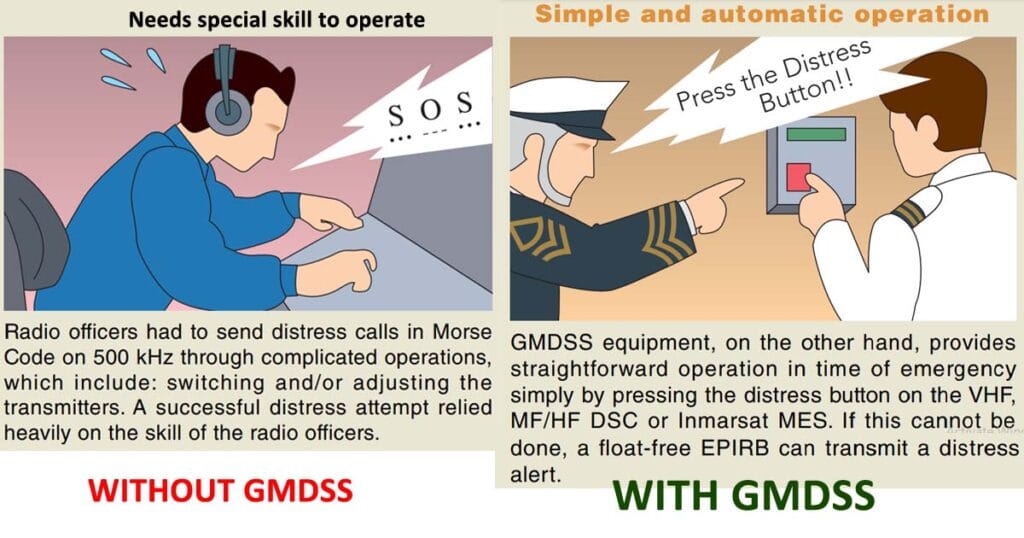
Introduced by the IMO and enforced under SOLAS Chapter IV, GMDSS replaced manual Morse code communication with automated distress signaling.
This modern system ensures rapid response and coordination during maritime emergencies regardless of a ship’s location at sea. 🌍⚓
✅ Key Fact: All SOLAS-compliant cargo and passenger vessels on international voyages must carry GMDSS equipment suited to their operating sea area.
🔍 Why GMDSS Matters
Before GMDSS, distress communication heavily relied on Radio Officers decoding Morse Code. If the officer wasn’t onboard, the ship couldn’t legally sail.
But with GMDSS, even a junior officer with a valid GMDSS General Operator Certificate (GOC) can send an emergency alert using Digital Selective Calling (DSC), EPIRBs, or Inmarsat terminals.
GMDSS allows:
- Automatic distress alerting
- Global ship-to-ship, ship-to-shore, and SAR coordination
- Maritime safety broadcasts
Whether you’re navigating within VHF range or sailing the polar seas, GMDSS ensures someone always knows when you’re in trouble.
🧭 What Are the Core Components of GMDSS?
Each piece of GMDSS equipment performs a critical function– from transmitting distress signals to receiving meteorological and navigational warnings.
If a unit can send or receive distress alerts, it’s part of the GMDSS system.
Below are the most essential components required onboard, depending on the ship’s size and area of operation.
1. 🛰️ 406 MHz EPIRB (Emergency Position-Indicating Radio Beacon)
An EPIRB is a float-free emergency beacon that transmits a distress signal on the 406 MHz frequency.
Once activated, either manually or automatically during sinking, it sends your location to the COSPAS-SARSAT satellite network, which relays the signal to Local Earth Stations (LES) for Search and Rescue (SAR) deployment.
🔧 Mounting Tip: EPIRBs must be installed in a float-free bracket outside the accommodation area for automatic activation if the ship sinks.

2. 📡 Search and Rescue Transponder (SART)
A SART is a radar-responder device that assists rescuers in locating survival crafts during distress.
When it detects radar signals from X-band marine radars, it transmits a series of dots or arcs on the radar display, helping SAR units home in on your position.
🚢 Carriage Requirements:
- 1 SART for cargo ships/MODUs between 300 GT and 500 GT
- 2 SARTs (port and starboard) for cargo ships over 500 GT and all passenger vessels
🧰 These should be easily accessible for quick transfer to lifeboats or life rafts during abandon-ship situations.
3. 📞 Portable VHF Transceivers
Handheld VHF radios are critical for ship-to-ship and ship-to-shore voice communication, especially during emergencies and abandon-ship scenarios.
They must be capable of operating on Channel 16, the international distress, safety, and calling frequency.
⚓ Carriage Requirements:
- 2 portable VHFs for ships between 300–500 GT
- 3 portable VHFs for ships over 500 GT and all passenger vessels
✅ These radios are essential for lifeboat communication, bridge-wing operations, and muster station coordination.
4. 📻 VHF Radio Installation (Fixed Unit)
Fixed Very High Frequency (VHF) installations are essential for routine and emergency communications.
They must support:
- Channel 06, 13, and 16 (distress, intership, and bridge-to-bridge)
- Continuous DSC watch on Channel 70
- DSC distress alert transmission on CH 70
💡 Note: DSC (Digital Selective Calling) enables automated digital alerting with preformatted distress messages- ensuring rapid identification and response.
📊 GMDSS Radio Frequency Bands
Understanding radio frequency ranges helps seafarers determine which equipment suits their voyage area.
| Band | Frequency Range | Primary Use |
| MF | 300 kHz – 3 MHz | Medium-range alerts |
| HF | 3 MHz – 30 MHz | Long-range or oceanic communication |
| VHF | 30 MHz – 300 MHz | Short-range line-of-sight (≈20–30 NM) |
These bands are used by different GMDSS components, especially VHF installations, MF/HF radios, and DSC-capable systems.
5. 🧾 NAVTEX Receiver (Navigational Telex)
NAVTEX is a key component for receiving Maritime Safety Information (MSI) including:
- Navigational warnings
- Weather forecasts
- Urgent safety alerts
NAVTEX operates on 518 kHz (international English language transmissions) and 490 kHz for national or regional broadcasts.
🚨 Requirement:
Ships must carry one NAVTEX receiver unless service is unavailable in their operating region.
In that case, alternatives such as:
- Inmarsat Enhanced Group Calling (EGC)
- HF direct-printing telegraphy
…must be provided for MSI reception.
6. 🌐 INMARSAT System
INMARSAT is a satellite communication network that provides global voice and data services.
It supports distress alerting, SAR coordination, routine ship-shore messaging, and SafetyNET MSI broadcasts.
🛰️ Developed under the International Maritime Satellite Organization (INMARSAT, now privatized), it remains mandatory for GMDSS compliance in Sea Area A3.
INMARSAT Services Used in GMDSS:
- Inmarsat-B/Fleet: For voice/data communication
- Inmarsat-C: For distress alerts and MSI
7. 📶 Digital Selective Calling (DSC)
Digital Selective Calling (DSC) is the backbone of GMDSS alerting.
It automates ship-to-ship, ship-to-shore, and shore-to-ship communications using digitally encoded distress messages, ensuring faster SAR response with minimal human input.
🔑 Core Features:
- Transmits preformatted emergency alerts over VHF, MF, or HF
- Alerts can be directed to individual ships, groups, or all stations
- Uses Channel 70 (VHF) and 2187.5 kHz (MF) for DSC alerts
📜 IMO Resolution MSC.511(105) standardizes the performance and use of DSC across all GMDSS-capable vessels.

🌊 GMDSS Sea Areas and Required Equipment
GMDSS divides the world’s oceans into four Sea Areas, each with specific equipment requirements based on proximity to shore-based facilities.
| 🌍 Sea Area | Description | Minimum Equipment |
| A1 | Within VHF range of a coast station (≈20–30 NM) | VHF Installation, 406 MHz EPIRB |
| A2 | Outside A1, within MF coast station range (≈100 NM) | VHF, MF, 406 MHz EPIRB |
| A3 | Outside A1 & A2, within INMARSAT coverage (≈76° N/S) | VHF, MF/HF or INMARSAT, 406 MHz EPIRB |
| A4 | Polar regions, outside A1–A3 | VHF, MF/HF, 406 MHz EPIRB |
⚠️ Ships must be equipped according to the farthest sea area they sail through. INMARSAT isn’t reliable in A4 (Polar Regions)– thus, MF/HF radios are mandatory there.
📋 GMDSS: 9 Functional Requirements
To ensure safety and regulatory compliance, GMDSS equipment must collectively fulfill 9 key communication functions:
- 🚨 Ship-to-shore distress alerting (via 2 independent systems)
- 📡 Shore-to-ship distress alerts
- 🆘 Ship-to-ship distress alerts
- 🧭 SAR coordination communications
- 🔊 On-scene communications
- 📍 Locating signals (e.g., SART, EPIRB)
- 🌦️ Maritime Safety Information (MSI)
- 📤 General radiocommunications to/from shore
- 🗣️ Bridge-to-bridge communication
All deck officers operating GMDSS gear must hold a valid General Operator’s Certificate (GOC), ensuring they can manage communications during any emergency.
✅ Conclusion: Why GMDSS Knowledge Matters
GMDSS is more than just a requirement, it’s a life-saving system that can mean the difference between rescue and tragedy.
In the vast and often unpredictable oceans, being equipped with, and trained on, GMDSS gear is vital for every officer.
🎯 Stay prepared. Know your sea area. Master the equipment.
This knowledge ensures not just compliance, but confidence and safety at sea.
❓FAQ: Global Maritime Distress and Safety System (GMDSS)
What does GMDSS stand for?
GMDSS means Global Maritime Distress and Safety System– a system that automates emergency communication for ships worldwide.
What equipment is required for GMDSS?
Common GMDSS equipment includes EPIRB, SART, VHF/MF/HF radios, DSC, INMARSAT, and NAVTEX, depending on your sea area.
Is GMDSS mandatory for all vessels?
GMDSS is mandatory under SOLAS Chapter IV for cargo ships ≥300 GT and all passenger vessels on international voyages.
Can you use a GMDSS radio without a certificate?
No. Only certified officers with a GMDSS General Operator’s Certificate (GOC) may operate GMDSS radios.
What’s the main purpose of GMDSS?
To ensure that ships in distress can automatically alert rescue authorities and nearby vessels, reducing response time and increasing survival chances.
May the winds be in your favor.
Leave a Reply