

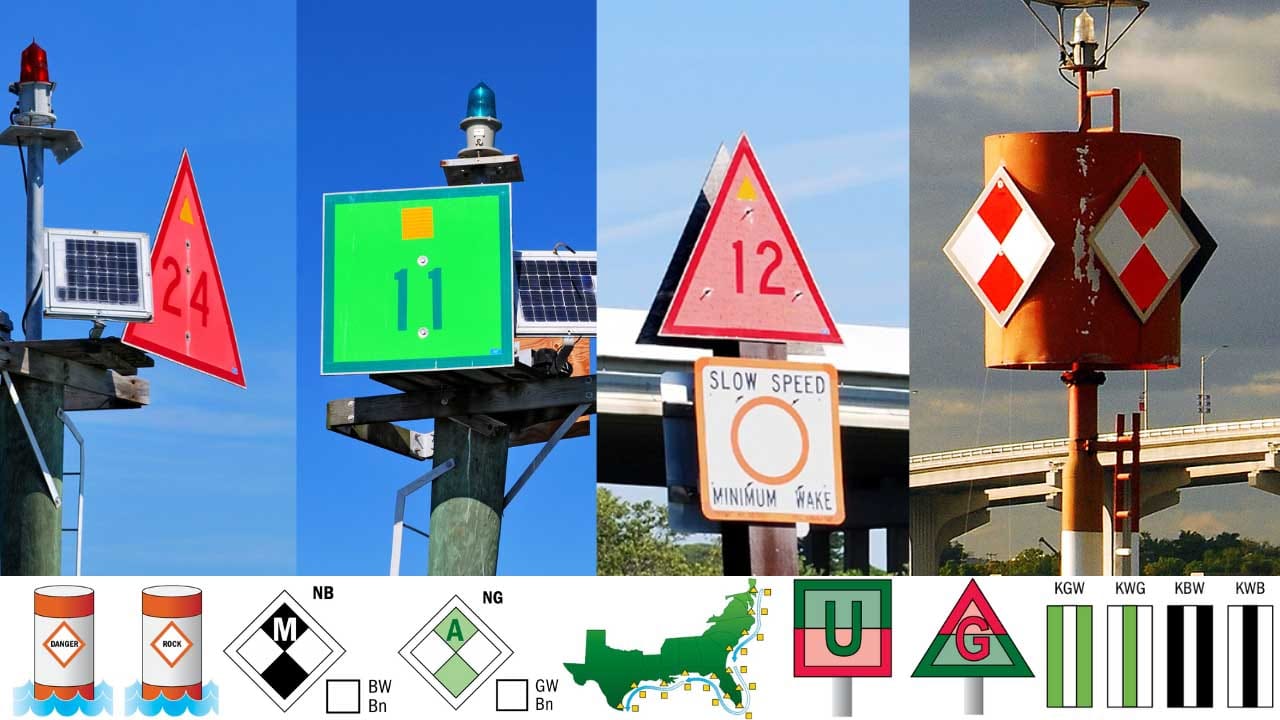
The IALA Maritime Buoyage System (IALA-MBS) standardizes aids to navigation (AtoNs) globally under Region A and Region B.
Most countries align with this system, but the United States operates its own buoyage system with unique practices and deviations.
Some of these differences directly contradict IALA standards, posing a risk to international mariners unfamiliar with U.S. conventions.
This guide outlines 8 key features exclusive to U.S. waters that are not found in IALA-MBS.
Understanding these helps ensure safe navigation, especially when transitioning between international and U.S. waterways. 🌍⚓
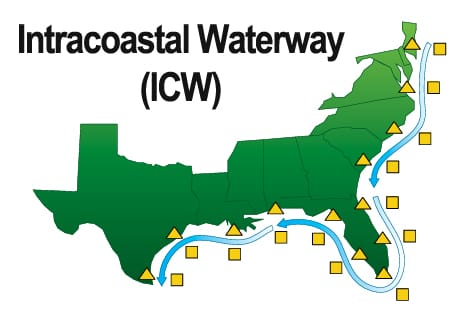
1. 🟡 Intracoastal Waterway (ICW) Marking System
The Intracoastal Waterway (ICW) is a 3,000-mile inland navigation route stretching along the Atlantic and Gulf coasts.
It overlays existing lateral buoyage with yellow symbols– a feature not found in IALA-MBS.
ICW Symbol Meanings:
- Yellow Square 🟨 – Keep it to port (left) when heading from New Jersey to Texas (southbound).
- Yellow Triangle 🔺 – Keep it to starboard (right) when southbound on the ICW.
- Horizontal Yellow Band – Identifies a buoy as part of the ICW.
These markings overlay existing U.S. buoys (red/green) and are critical for route-following in inland waters. IALA-MBS does not use such overlays.
2. 🌊 Western Rivers Marking System
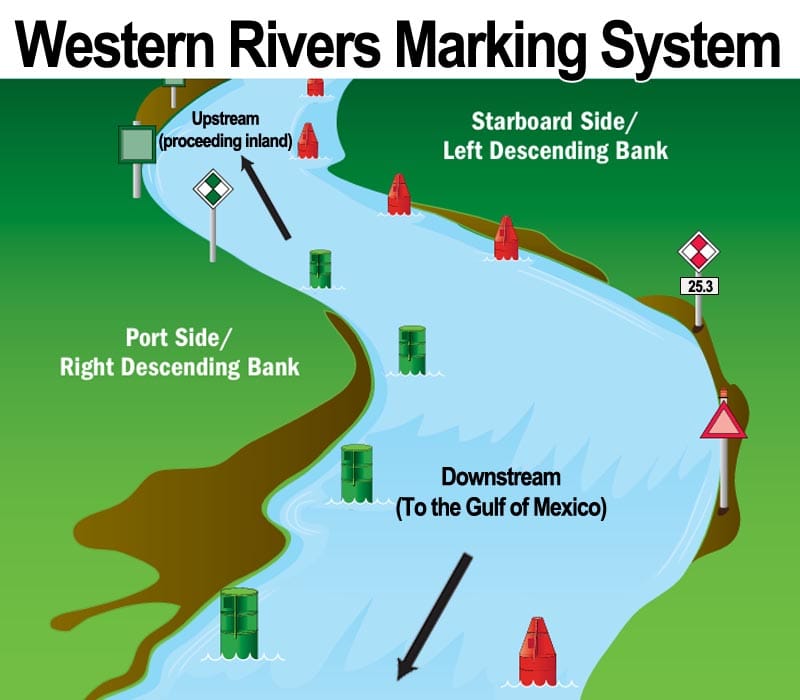
Used on the Mississippi River and its tributaries above Baton Rouge, LA, this system is exclusive to the U.S. and follows principles unrelated to IALA.
Key Features:
- No buoy numbers.
- Beacon numbers show river mileage from the mouth, not lateral position.
- Green AtoNs: Single flash (green or white).
- Red AtoNs: Group Flashing (2) in red or white.
- No isolated danger marks.
- Dayboards are diamond-shaped, not IALA-style.
Designed for current-following navigation, this system is vital for inland river traffic and does not conform to international buoyage standards.
3. 🔴 “Red Right Returning” – Region B Buoyage Rule
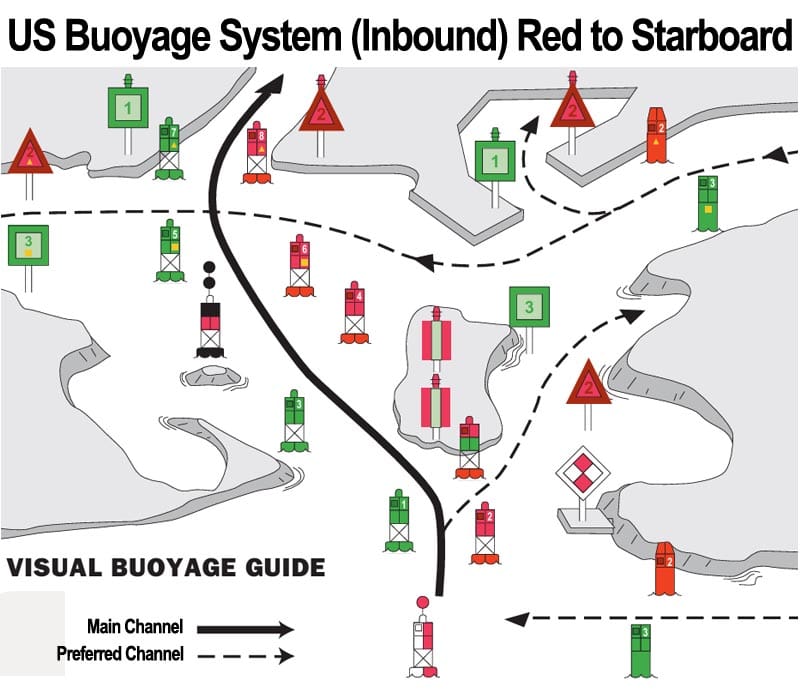
Unlike IALA Region A, where green buoys go to starboard when entering a harbor, the U.S. (IALA Region B) follows the “Red Right Returning” rule:
In U.S. Waters (Conventional Direction of Buoyage):
- Red buoys ➤ Starboard when entering from sea.
- Green buoys ➤ Port side when entering.
Additionally, U.S. junction markers include:
- Preferred channel to starboard: Green top band.
- Preferred channel to port: Red top band.
This system directly contradicts IALA Region A, so navigators must double-check buoy regions to avoid misinterpretation.
4. ◇ Diamond-Shaped Dayboards
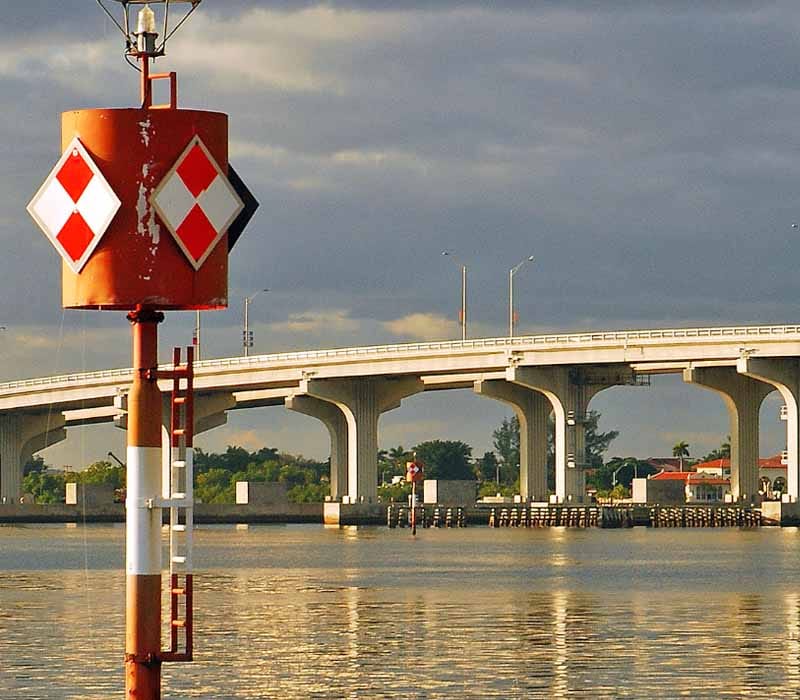
Dayboards are fixed visual aids mounted on structures or piles, often seen on inland waterways.
While not addressed in IALA-MBS, they are standard in U.S. navigation systems.
U.S. Dayboard Types:
- Red, Green, or Black diamonds on white backgrounds.
- Often marked with letters like NR, NG, or NB (Non-lateral Red, Green, or Black).
- Aid chart-based navigation during daylight.
Think of them as “You Are Here” signs for mariners. They’re essential for position confirmation along U.S. routes but have no equivalent in the IALA framework.
5. 🎯 Colored Range Boards (Leading Marks)
In the IALA system, Leading Lights or range markers are usually white with specific light characteristics.
In contrast, U.S. Range Boards can be:
- Red, Green, White, or Black to improve visibility against background terrain.
- Displayed in pairs, with the front (lower) and rear (higher) markers aligned vertically to show the correct channel line.
While the function is similar to IALA’s leading lights, the color usage and naming conventions differ, and range boards may not be illuminated.
6. 🟧 Informational & Regulatory Marks
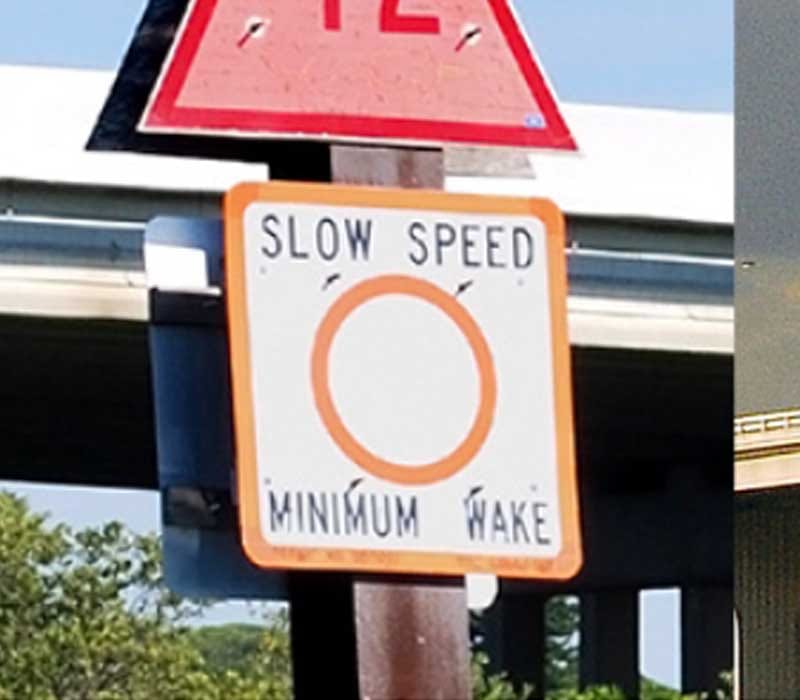
U.S. waters use regulatory buoys and markers that display orange geometric symbols on white backgrounds.
These do not exist in IALA-MBS but are critical for coastal and inland safety.
Meaning of Orange Symbols:
- 🔶 Diamond – Danger: hazards like rocks, shoals, or wrecks.
- ⭕ Circle – Restricted operations: no wake zones, speed limits.
- ❌ Diamond with Cross – Exclusion zones: no entry.
- ▢ Square – General information: directions, distances, marinas, etc.
These marks are used extensively in U.S. inland waterways and lakes but are not recognized under IALA standards.
7. ⚠️ Special Marks Without the “X” Topmark
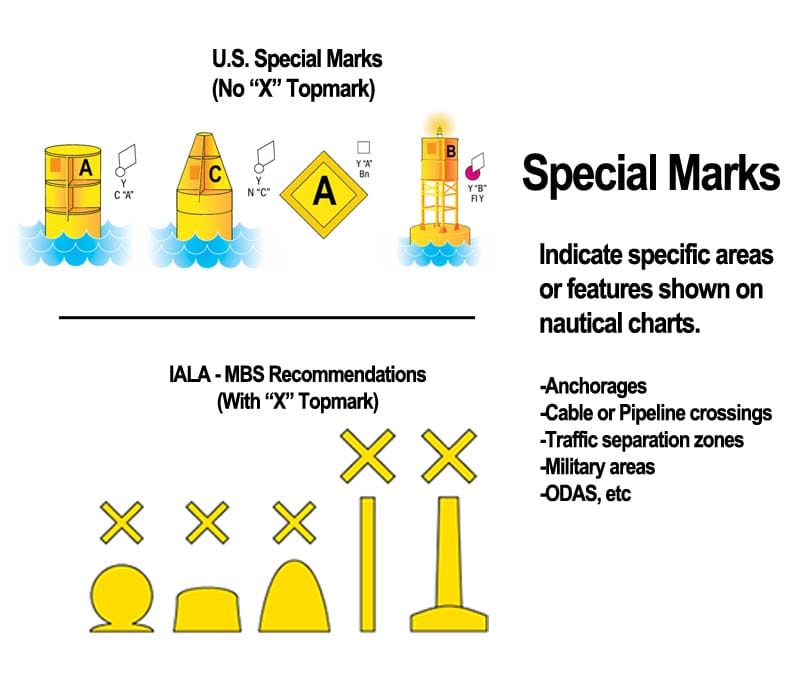
Special marks indicate features not used for safe passage but for identifying areas like:
- Anchorages
- Pipeline crossings
- Military zones
- Traffic separation schemes
- Scientific buoys (ODAS)
In IALA:
- Yellow buoys
- Yellow “X” topmark
- Flashing yellow light
In U.S.:
- Same yellow color
- No topmark (often omitted)
- May be unlit or flashing yellow
Absence of the “X” can confuse international mariners who rely on topmarks as per IALA-MBS. This subtle difference has practical safety implications.
🧭 What This Means for Navigators
If you’re navigating in U.S. waters- especially as a foreign-flagged vessel, you must understand that AtoNs follow unique conventions not aligned with IALA-MBS.
Key Takeaways:
- U.S. buoyage integrates region-specific rules, inland systems, and visual aids absent in IALA.
- Some aids look visually similar but serve opposite functions (e.g., red buoys in Region B).
- Overlooking these differences can lead to navigational errors or safety violations.
✅ Always consult U.S. Coast Pilot, Light Lists, or NOAA charts when entering U.S. waters.
❓ FAQ: U.S. vs IALA Buoyage
What is the “Red Right Returning” rule?
It’s a U.S. convention where red buoys must be kept on the starboard side when returning from sea or heading inland, unlike IALA Region A.
Does the U.S. use IALA Region A or B?
The United States uses IALA Region B, along with additional local systems like ICW and Western Rivers Marking.
Are U.S. buoys compatible with IALA standards?
Partially. Some visual elements align, but several rules and symbols differ or are not used internationally.
Do dayboards exist in IALA?
Not in the same form. Diamond-shaped dayboards are a uniquely U.S. AtoN convention used for inland visual navigation.
🧭 Conclusion: Stay Buoy-Aware in U.S. Waters
The U.S. buoyage system diverges significantly from IALA-MBS through its inland overlays, color schemes, and regional rules like the ICW and Western Rivers systems.
📌 For international mariners:
Don’t assume global consistency, study the local AtoNs before entering U.S. waters.
Awareness prevents misinterpretation, violations, and accidents.
May the winds be in your favor.
Leave a Reply