


Changing the ship’s time is a routine task that affects navigation, logkeeping, and crew schedules.
It’s done to match port time, adjust for time zones, or comply with Daylight Saving Time (DST).
Though it may seem minor, incorrect time adjustments can cause watchkeeping confusion, log discrepancies, and even disputes among the crew.
This guide explains when and how to change the ship’s time and how to avoid costly mistakes at sea.
🕰️ Why Do Ships Adjust Their Clocks?
Adjusting the ship’s time is more than just updating your wristwatch- it’s about aligning the entire vessel’s operations with global and local expectations.
Below are the main reasons ships change their clocks.
🛳️ 1. To Match Local Port Time and Avoid Miscommunication
Ships frequently synchronize their clocks with local time to align with port authorities, loading masters, surveyors, and agents.
This helps ensure that log entries, official records, and cargo operations are all documented using the same time zone.
💡 Example: During loading operations on a tanker, jetty personnel often ask for the exact time the loading arm was connected. If ship and shore time differ, it can cause discrepancies in official records.
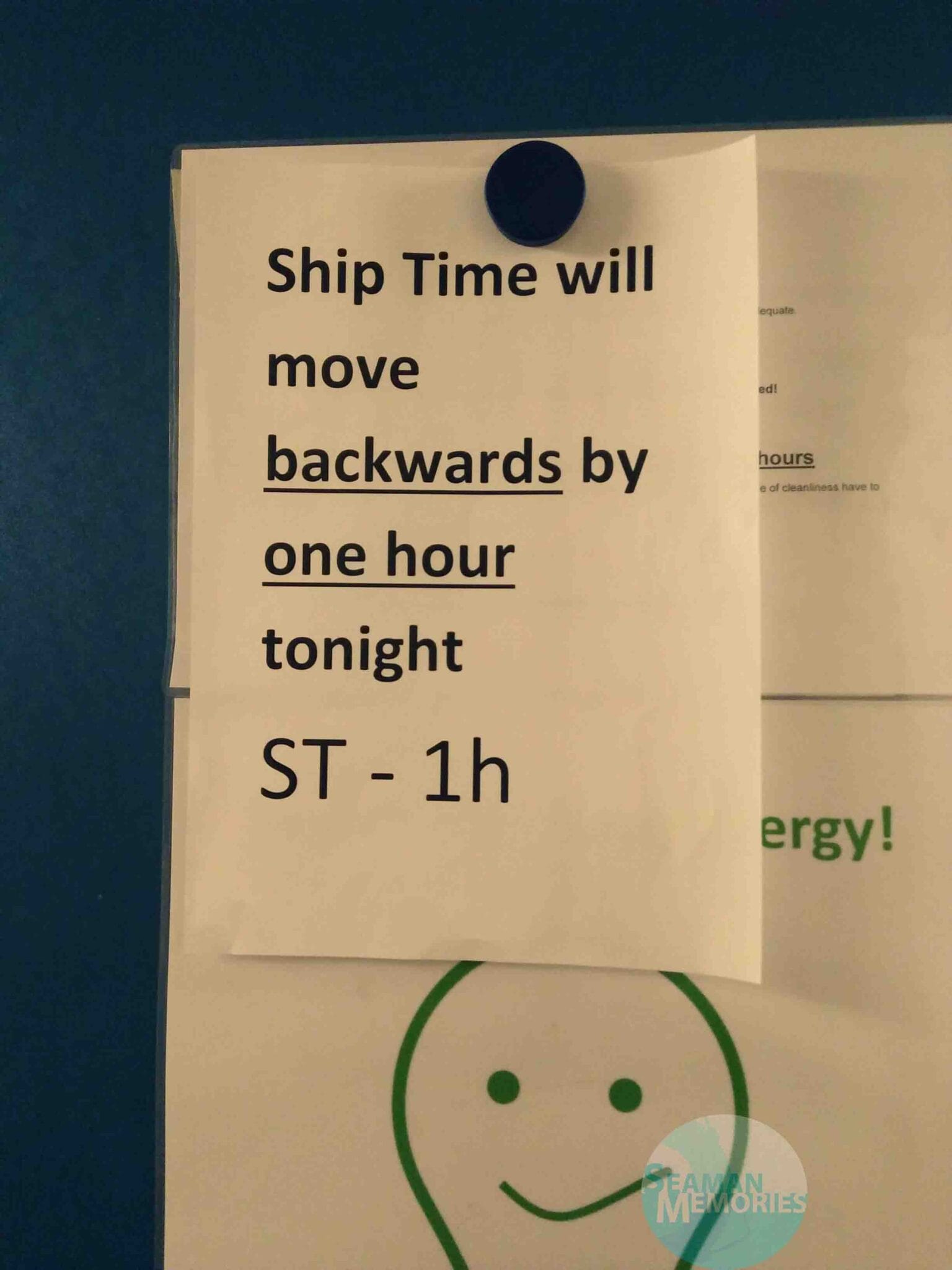
🌐 2. When Crossing Time Zones During Long Voyages
On eastbound or westbound voyages, especially transoceanic ones, ships often cross multiple time zones.
According to maritime convention, the ship’s time should be adjusted by one hour for every 15° of longitude passed.
📌 Example: A voyage from India to Mexico may involve up to 10 one-hour clock retards. If not done correctly, this could lead to inconsistent log entries and fatigue among specific watch teams.
🕓 3. To Comply with Daylight Saving Time (DST)
Some countries observe Daylight Saving Time, adjusting clocks forward in summer and backward in winter to optimize daylight hours.
If a ship is in or near such countries during the DST switch, the vessel must comply to ensure legal and operational alignment.
Countries using DST include:
- Most of Europe
- North America
- Russia
- Parts of Australia
📌 Not all nations follow DST. Most equatorial and tropical countries do not observe it.
🧾 4. To Maintain Accurate Documentation and Logs
Accurate timekeeping is essential for compliance with SOLAS, charter party agreements, and port state inspections.
Logs must reflect correct local or agreed time, especially during:
- Port arrivals and departures
- Cargo operations
- Engine room events
- Incident reports
Adjusting the ship’s time to match local time also demonstrates professionalism and cooperation with the host country.
🧭 Who Decides the Ship’s Time?
The Navigation Officer, under the Master’s guidance, is responsible for monitoring and adjusting the ship’s time.
This includes:
- Tracking the ship’s longitude and calculating time zone boundaries
- Monitoring for areas that observe Daylight Saving Time (DST)
- Coordinating with shore authorities for synchronization
These adjustments are typically announced via the bridge logbook, posted memos, or the ship’s PA system.
All departments- deck, engine, catering, must align with the new ship’s time once declared.

👥 How Time Adjustments Affect Watchkeepers
A one-hour clock change may seem minor, but it significantly impacts the 4-hour watch system.
Depending on whether the clock is advanced or retarded, one watch team may:
- Work 20 minutes more or less
- Get less rest or sleep
- Suffer from watch overlap confusion
- Raise concerns over fairness, especially on longer voyages
🔁 Clock Retard (Move Back 1 Hour)
- The day becomes 25 hours
- Watchkeepers work 4 hours and 20 minutes
- Usually considered unfair if always assigned to one watch
⏩ Clock Advance (Move Forward 1 Hour)
- The day becomes 23 hours
- Watchkeepers work 3 hours and 40 minutes
- Seen as favorable due to shorter duty time
😎 None watchkeepers shouldn’t have problems with this. They just have to set the new time on their phone at night.
🤯 Why a 1-Hour Change Can Create Confusion
Let’s say a 12–4 watch is on duty when time is retarded at 02:00 (old time), making it 01:00 again (new time).
That team ends up working an extra hour.
Over a multi-week voyage, the same team may absorb all time changes, leading to fatigue or disputes.
To prevent this, ships adopt equal distribution methods though these can also confuse newer crew members if not briefed clearly.
⏳ Common Methods to Adjust Ship’s Time
1. 🧮 Dividing the One-Hour Change by Three Watchkeepers
Each of the three watch groups (8–12, 12–4, and 4–8) takes 20 minutes of the change.
This is the most common solution and is seen as fair.
Problems?
- Difficult to track without a clear time reference
- Leads to uncertainty on when to wake up or go on watch
- Often causes overlapping if the wrong “base time” is used (old vs. new)
2. 🔄 Rotating Time Changes Across Voyages
Another effective approach: assign entire 1-hour changes to different watches on a rotating schedule during long voyages.
Example:
- Monday – 1 hour advance for 12–4 watch
- Wednesday – 1 hour for 4–8
- Saturday – 1 hour for 8–12
This keeps things fair, avoids split adjustments, and makes logging simpler.
But this only works if the entire voyage has three or six time changes.
3. 🧍 One Watchkeeper Takes All Changes
Sometimes, the same team voluntarily takes all advances and retards- especially if port calls are few and voyages are short.
Important: This must be agreed upon by all watchkeepers to avoid morale issues or complaints.
⏩ Clock Advance: What Happens When Time Moves Forward by 1 Hour
When the ship’s time is advanced, one full hour is removed from the day making it just 23 hours long.
To distribute the burden fairly, each watchkeeper reduces their duty by 20 minutes.
📌 Golden Rule:
Advancing the clock = 20 minutes less duty per watchkeeper
For clarity, we’ll use the old time as the reference when calculating the 20-minute share.
This helps ensure smoother coordination and less confusion during the transition.
🕗 20:00–00:00 (8 to 12 Watch)
- Start time: 20:00H (Old Time)
- Relieved at: 23:40H (Old Time)
- Watch Duration: 3 hours and 40 minutes
- ✅ This group gets off early by 20 minutes.
🕛 00:00–04:00 (12 to 4 Watch)
- Arrive at bridge: On or before 23:40H (Old Time)
- Ship’s clock is advanced by 20 minutes at handover
- Ends at: 03:20H (Old Time)
- ✅ Total duty: 3 hours and 40 minutes
⏱ Important: The relieving officer must be alerted early to arrive on time using the unadjusted clock.
🕓 04:00–08:00 (4 to 8 Watch)
- Arrive at: 03:20H (Old Time)
- Watch starts at: 03:40H (New Time)
- Ends at: 08:00H (New Time)
- ✅ Their share of 20 minutes means they also work 3h 40m total.
🕗 08:00–12:00 (8 to 12 Day Watch)
This group often has the least issue with time changes.
✅ Before sleeping, they adjust their clocks 1 hour forward.
✅ When they wake up, their personal time is synced with the ship’s new time.
This makes their transition smooth, especially since breakfast schedules, drills, and work routines also follow the new ship time.
🧠 Summary of Clock Advance Logic
| Watch Group | Start (Old Time) | End (Old Time) | Total Duty |
|---|---|---|---|
| 8 to 12 | 20:00 | 23:40 | 3h 40m |
| 12 to 4 | 23:40 | 03:20 | 3h 40m |
| 4 to 8 | 03:20 | 08:00 (new) | 3h 40m |
⚠️ Always use the old time as the planning reference
🔁 Update personal watches/clocks after your watch ends
⏪ Clock Retard: What Happens When Time Moves Backward by 1 Hour
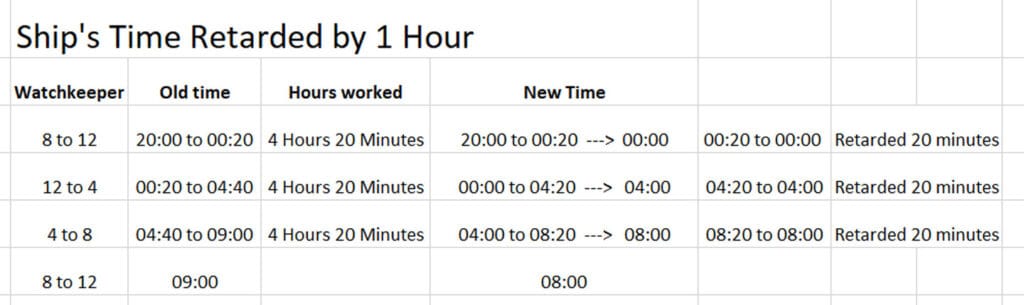
When the ship’s time is retarded, the day becomes 25 hours long.
This adds 1 full hour to the day, and each watchkeeper works 20 minutes more to fairly distribute the change.
📌 Golden Rule:
Retarding the clock = 20 minutes extra duty per watchkeeper
For consistency, we still use the old time as the reference to avoid confusion when applying the additional time.
🕗 20:00–00:00 (8 to 12 Watch)
- Start time: 20:00H (Old Time)
- Relieved at: 00:20H (Old Time)
- ✅ Total duty: 4 hours and 20 minutes
- 📌 20 minutes added before handing over the watch
🕛 00:00–04:00 (12 to 4 Watch)
- Arrive at bridge: 00:20H (Old Time)
- Clock is retarded by 20 minutes after watch begins
- Ends at: 04:40H (Old Time)
- ✅ Watch duration: 4 hours and 20 minutes
🔔 Important: Wake up 20 minutes later than usual, but arrive based on the old time so you stay aligned.
🕓 04:00–08:00 (4 to 8 Watch)
- Relieve at: 04:40H (Old Time)
- Watch starts at: 04:20H (New Time after applying 20 minutes backward)
- Ends at: 08:00H (New Time)
- ✅ Total duty: 4h 20m
🕗 08:00–12:00 (8 to 12 Day Watch)
This group prepares by retarding their clocks 1 hour before going to bed. When they wake up, their personal time matches the ship’s adjusted time.
They begin their shift like usual, with no complications- assuming all prior adjustments were done properly.
🧠 Summary of Clock Retard Logic
| Watch Group | Start (Old Time) | End (Old Time) | Total Duty |
|---|---|---|---|
| 8 to 12 | 20:00 | 00:20 | 4h 20m |
| 12 to 4 | 00:20 | 04:40 | 4h 20m |
| 4 to 8 | 04:40 | 08:00 (new) | 4h 20m |
📚 Tip:
Note adjustments clearly in the Bridge and Engine Room logs
🟨 Golden Rule for Ship’s Time Adjustments
Whether the ship’s time is advanced or retarded:
- ⏩ Advance = each watch works 3 hours and 40 minutes
- ⏪ Retard = each watch works 4 hours and 20 minutes
Using old time as the reference simplifies coordination.
Communicate clearly across teams and use posted memos to avoid confusion.
✅ Best Practices for Time Zone Changes at Sea
- Always use old time when applying the change
- Coordinate across all departments- deck, engine, and galley
- Use rotational adjustments for long voyages
- Note time changes in the bridge log, engine log, and handover notes
- Announce the change early- via PA system, whiteboard, or memos
❓ FAQ: Time Adjustments on Ships
Q: Who decides when to change the ship’s time?
🧭 The Navigation Officer monitors time zones and coordinates with the Master to schedule adjustments.
Q: Do all countries follow Daylight Saving Time?
🌍 No. DST is mostly used in the Northern Hemisphere (e.g., USA, Europe, parts of Australia). Tropical countries typically don’t follow it.
Q: What happens if we don’t adjust time during a voyage?
🕒 Incorrect timekeeping can lead to log mismatches, legal issues, and operational delays in port.
Q: Should cadets worry about time changes?
🎓 Cadets should learn time-change procedures early. It affects their future watch duties and shows professionalism.
⚓ Conclusion: Time Change Doesn’t Have to Be Confusing
Adjusting ship time- whether advancing or retarding, keeps the vessel aligned with legal, navigational, and operational standards.
With clear communication, equal distribution of duties, and proper reference times, any seafarer can handle time changes like a pro.
Stay sharp. Log everything. And always double-check your clock before watch! 🕒🧭
May the winds be in your favor.
Leave a Reply